Renault Captur Hybrid 2024
Ce qu'il faut retenir
Batterie
1.2 kWh
Puissance
145 ch
0–100 km/h
10.6s 0–100 km/h
Prix
dès 28 900 €
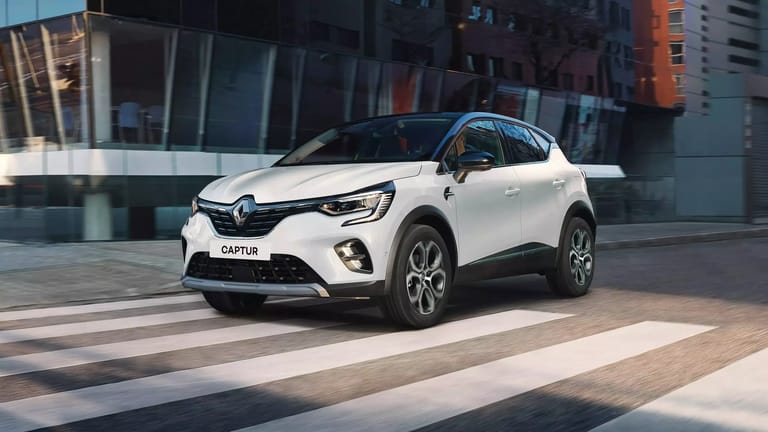
The 2024 Renault Captur Hybrid positions the French urban SUV in a register of mechanical simplicity. Unlike plug-in hybrids requiring an outlet, this Captur operates on a conventional HEV system: petrol engine coupled to a small 1.2 kWh battery that recharges during deceleration. The stated objective is to reduce urban fuel consumption by 40% without requiring drivers to manage external charging. With 145 horsepower and an entry price of €28,900, it targets compact SUV buyers seeking efficiency without sacrificing range.
Design and habitability
The Captur Hybrid adopts the recognizable urban SUV shapes of the brand: 4,239 mm in length for dimensions suited to dense traffic. The 2,639 mm wheelbase ensures a proportioned interior, though rear legroom remains limited in the segment.
Boot volume reaches 326 litres in standard configuration, expandable to 440 litres with the rear seat folded. The latter features a 16 cm slide function, allowing flexible trade-offs between cargo space and rear seating. Weight held to 1,370 kg aids fuel consumption in the hybrid system's electric mode.
The 1,575 mm height provides good visibility, an appreciated asset in urban use. Evolution, Techno, and Alpine Spirit trim levels structure the offer without stylistic revolution: design remains sober and functional.
Engine and performance
The Captur Hybrid relies on a petrol engine combined with an HEV system and 1.2 kWh battery. Combined power reaches 107 kW (145 horsepower) for a top speed of 170 km/h. Acceleration from 0 to 100 km/h occurs in 10.6 seconds: honest figures for the segment without sports pretension.
The system's appeal lies less in raw performance than in energy management. The battery captures energy during braking and deceleration, which the electric motor restores during gentle acceleration or urban driving. The power-to-weight ratio remains balanced for this vehicle type.
Transmission is straightforward front-wheel drive; no all-wheel drive option is offered. For standard road use and urban driving, this configuration suffices. An Extended Grip mode improves traction on snowy or muddy surfaces.
Range and charging
The Captur Hybrid does not rely on external charging: the 1.2 kWh battery regenerates only during driving. This advantage offers freedom of movement identical to traditional petrol engines, without requiring access to an outlet.
Energy benefit concentrates on urban use, where the battery reduces declared consumption by 40%. On motorways or long-distance journeys, the hybrid system provides lesser benefit: the petrol engine ensures continuous propulsion without notable electric motor assistance. Overall range is that of the petrol tank, unchanged from non-hybrid versions.
This approach particularly suits mixed urban-suburban journeys where stop-start cycles are frequent. For 100% motorway driving, the hybrid upcharge offers marginal gains.
Equipment and technology
The Captur Hybrid benefits from the Open R Link multimedia system with integrated Google services (Google Maps, Google Assistant). The 10.4-inch touchscreen features on Techno and Alpine Spirit trims, while Evolution offers a smaller display. Smartphone connectivity via Apple CarPlay and Android Auto is standard.
Level 2 semi-autonomous driving functions via contextual geolocation: it activates automatically on roads and motorways where legally permitted, without driver intervention. This staged approach by context limits false alerts from legislation changes across countries.
Comfort equipment includes manual or automatic air conditioning depending on version, fabric or fabric/leather seats on Alpine Spirit, and rear footrest. No additional accessible battery offers V2L (Vehicle-to-Load) function: only a standard 12V socket is available.
Versions & Prix
Evolution
28 900 €
- Batterie : 1.2 kWh
- Puissance : 145 ch (107 kW)
- 0–100 km/h : 10.6 s
- V max : 170 km/h
- Transmission : Traction
Techno
31 500 €
- Batterie : 1.2 kWh
- Puissance : 145 ch (107 kW)
- 0–100 km/h : 10.6 s
- V max : 170 km/h
- Transmission : Traction
Esprit Alpine
33 800 €
- Batterie : 1.2 kWh
- Puissance : 145 ch (107 kW)
- 0–100 km/h : 10.6 s
- V max : 170 km/h
- Transmission : Traction
Notre verdict
The 2024 Renault Captur Hybrid is a pragmatic urban SUV that delivers reduced fuel consumption without charging constraints, positioning well against conventional competitors in the segment with competitive pricing and accessible technology.
The interior offers a good driving position and correct visibility, but rear space remains tight for long journeys with five passengers.
Open R Link with integrated Google and level 2 contextual awareness are modern assets, but the absence of V2L and the smaller screen in the Evolution version limit the score.
At 28,900 euros, the hybrid Captur offers an accessible price with recent technology, but the reduced battery limits the ecological advantage compared to a simple petrol engine.
Points positifs
- + No-recharge range: identical usage freedom to petrol engines without mandatory infrastructure
- + 40% reduced consumption in urban cycle thanks to stop-and-go energy recovery
- + Entry price of €28,900 for a hybrid SUV from a mainstream brand, highly competitive
- + Native Google system with integrated services and intuitive ergonomics for this segment
- + Modular boot up to 440L with sliding rear seat offering useful flexibility
Points négatifs
- – 1.2 kWh battery: energy contribution concentrated only in dense urban use
- – Base boot of 326L limited for a family SUV compared to segment rivals
- – Front-wheel drive only: capabilities limited by bad weather and rough terrain
- – Modest 145 hp for long-distance acceleration and maximum load
- – No V2L despite onboard battery: 12V socket only for external power supply