Toyota C-HR Hybrid 2025
Ce qu'il faut retenir
Batterie
1.31 kWh
Puissance
122–184 ch
0–100 km/h
8s 0–100 km/h
Prix
dès 29 300 €
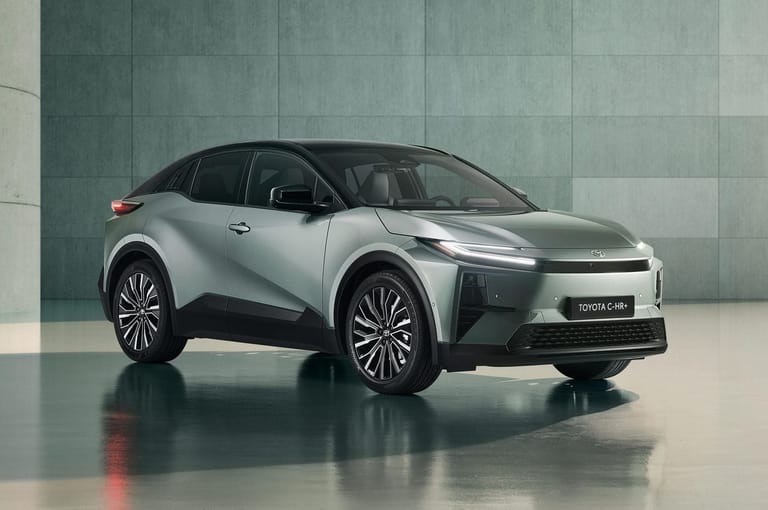
The Toyota C-HR Hybrid occupies the compact SUV segment, targeting urban and suburban drivers seeking controlled fuel consumption without charging constraints. Marketed since 2016 and regularly refined, this vehicle relies on Toyota's proven HSD hybrid system, available in two power levels: 122 horsepower or 184 horsepower. With a starting price of €29,300, it positions itself as an optimized combustion alternative rather than a transition to pure electric. Its approach remains the manufacturer's philosophy: prioritize range without charging, ease of use, and mechanical durability.
Design and habitability
The C-HR displays a distinctive compact SUV silhouette with dynamic proportions and elevated ground clearance. The cabin adopts practical daily-use logic: heated front seats with lumbar support, user-friendly control layout. The elevated driving position contributes to the sense of control appreciated by drivers in this segment, while visibility remains adequate despite prominent windshield pillars.
Interior design prioritizes modularity and easy cleaning, with mixed materials combining robust plastics and textured trim. The trunk, structured around the hybrid floorpan, offers storage suitable for daily commutes. The 1.31 kWh Ni-Mh battery is integrated under the rear seats, preserving useful space without significantly affecting passenger comfort.
Engine and performance
The C-HR Hybrid is based on Toyota's HSD (Hybrid Synergy Drive) system, available in two power versions. The 1.8L version develops 122 horsepower (90 kW) and 142 Nm of torque, combining a petrol engine and synchronized electric system via a continuously variable transmission. This variant accelerates from 0 to 100 km/h in 11 seconds for a maximum speed of 170 km/h.
The 2.0L version increases power to 184 horsepower (135 kW) and 202 Nm of torque, reducing 0 to 100 km/h acceleration to 8 seconds and raising maximum speed to 180 km/h. In both cases, front-wheel drive ensures stable traction in urban and highway conditions. The electric motor works in synergy with the combustion engine, optimizing fuel consumption during acceleration and deceleration phases.
Range and charging
Designed without an external rechargeable traction battery, the C-HR Hybrid offers no advertised electric range in the sense of pure electric vehicles. The hybrid system recharges exclusively through the petrol engine and energy recovery during braking. This approach eliminates any charging constraints but removes the possibility of fully electrified journeys. Overall range depends on combined combustion engine consumption and electric system deployment, with no standardized public WLTP data for this HEV technology.
The C-HR Hybrid's appeal lies in its complete freedom from external charging: a standard petrol fill-up is sufficient. This characteristic makes it accessible to users without charging points and suitable for long-distance travel without dedicated charging stops. The 1.31 kWh Ni-Mh battery ensures reliability and longevity without risks of degradation linked to repeated charge cycles.
Equipment and technology
C-HR equipment balances safety and connectivity. Toyota Safety Sense integrates pedestrian detection and driving assistance functions, meeting current safety standards. The 8-inch touchscreen supports Apple CarPlay and Android Auto, enabling smartphone integration and third-party navigation app access without restrictive proprietary interfaces.
Comfort features include heated front seats with lumbar support, useful on extended journeys. The intelligent parking assist system eases maneuvers in dense urban areas. The absence of external charging simplifies onboard technology management: no high-voltage battery management, no charging app, no V2L capability. This technological restraint reduces maintenance costs and promotes long-term reliability.
Versions & Prix
C-HR 1.8L HEV 122ch
29 300 €
- Batterie : 1.31 kWh
- Puissance : 122 ch (90 kW)
- Couple : 142 Nm
- 0–100 km/h : 11 s
- V max : 170 km/h
- Transmission : Traction
C-HR 2.0L HEV 184ch
34 000 €
- Batterie : 1.31 kWh
- Puissance : 184 ch (135 kW)
- Couple : 202 Nm
- 0–100 km/h : 8 s
- V max : 180 km/h
- Transmission : Traction
Notre verdict
The Toyota C-HR Hybrid is a reliable and efficient compact SUV, ideal for users seeking fuel economy without charging constraints. Positioned against pure combustion engines and some hybrid competitors (RAV4, Lexus NX), it offers a good balance between price and consumption for versatile everyday use.
Points positifs
- + Proven hybrid without charging: reliable on highway trips and long distances without charging infrastructure
- + Two power options (122 hp / 184 hp): flexibility to prioritize economy or performance based on driving profile
- + Attractive entry price: from €29,300 for a recognized compact SUV from premium Japanese brand
- + Elevated driving position: comfortable in city driving with good visibility, typical of compact SUV segment
- + Modern safety and connectivity: quality Toyota features with touchscreen and smartphone compatibility
Points négatifs
- – No 100% electric driving: even short trips remain permanently dependent on the combustion engine
- – Limited Ni-Mh battery: less energetic technology than lithium-ion, reduces real electric benefits
- – Unspecified weight and dimensions: impossible to assess precise energy efficiency of the C-HR
- – Higher consumption than pure combustion engines: hybrid surcharge does not systematically offset city driving costs
- – Lack of reliable WLTP data: difficult to compare real efficiency against direct competitors
FAQ
- What is the C-HR Hybrid's electric range?
- The C-HR offers no defined electric range, as it is a standard hybrid electric vehicle (HEV) without a rechargeable battery. Overall range depends on fuel consumption, with no standardized public WLTP data.
- How much does the C-HR Hybrid cost?
- Pricing starts at €29,300 for the 1.8L 122 hp version and reaches €34,000 for the 2.0L 184 hp version.
- Does it need to be charged?
- No, the C-HR Hybrid does not charge from the grid. The petrol engine and energy recovery during braking provide power. A standard petrol fill-up is all that's needed.
- What battery does it have?
- A 1.31 kWh Ni-Mh battery, integrated under the rear seats. This technology ensures durability without accelerated degradation, but does not allow 100% electric driving.
- What are its performance figures?
- The 1.8L 122 hp version accelerates from 0 to 100 km/h in 11 seconds (max speed 170 km/h). The 2.0L 184 hp version does 0 to 100 km/h in 8 seconds (max speed 180 km/h).