MG ZS EV 2021
Ce qu'il faut retenir
Autonomie
440 km WLTP
Batterie
51–72 kWh
Puissance
156–177 ch
0–100 km/h
8.6s 0–100 km/h
Recharge rapide
92 kW DC
Prix
dès 33 990 €
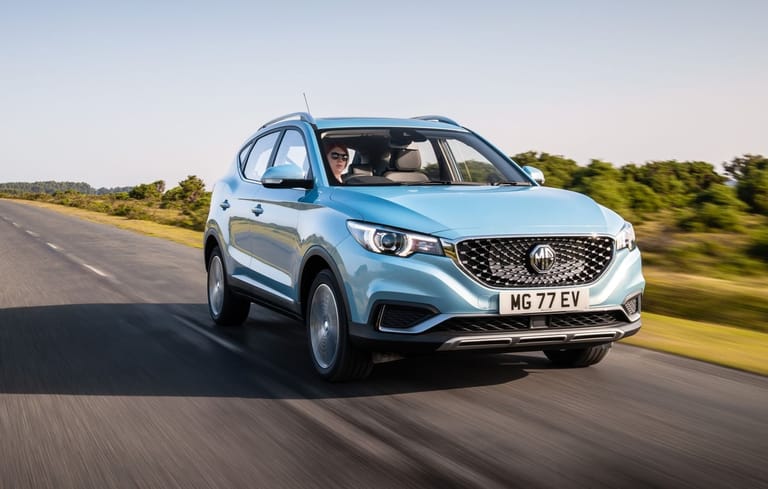
The MG ZS EV represents the Chinese manufacturer's attempt to access the European market with a compact electric SUV displaying an aggressive pricing strategy. Launched in 2021, this vehicle fits the urban and peri-urban SUV segment, competing against models like the Hyundai Kona Electric or Kia Niro EV. Offered in two battery levels (51 kWh and 72 kWh) and two trims (Comfort and Luxury), the ZS EV relies on affordability rather than spectacular performance. However, its limited availability in Europe and the brand's progressive withdrawal from this segment make its market offer residual today.
Design and habitability
The ZS EV adopts the angular and streamlined lines typical of contemporary compact SUVs. With 4.32 m length and 1.81 m width, it offers controlled dimensions for urban driving. The 2.58 m wheelbase provides balance between external compactness and interior space. Habitability proves adequate for four passengers, without excelling for the fifth seat which suffers from lack of roominess.
The trunk displays 448 liters in standard configuration, expandable to 1,166 liters with rear seat folding. This modularity enables versatile use for daily trips with occasional luggage. The Luxury trim stands out with a panoramic sunroof adding brightness and a sense of space, alleviating the perception of internal compactness. Interior materials remain standard for the price range, without premium ambition.
Engine and performance
The ZS EV comes in two synchronous motor variants: a 130 kW (177 hp) version on 51 kWh batteries, and a 115 kW (156 hp) version paired with the 72 kWh pack. Both develop identical torque of 353 Nm, offering acceptable urban launch reactivity. The absence of power difference between the two variants makes the choice mainly dependent on desired range rather than marked dynamic differences.
Acceleration from 0 to 100 km/h occurs in 8.6 seconds, an average time for the segment. Maximum speed of 175 km/h, common to both variants, offers no particular dynamic interest but remains sufficient for highway use. Front-wheel drive is the only option, with independent suspension ensuring adequate handling on urban roads and regional highways. No weight data has been communicated, which limits evaluation precision of the power-to-weight ratio.
Range and charging
The 51 kWh battery provides WLTP range of 320 km, realistic for daily use on short and medium distances. The 72 kWh pack increases this capacity to 440 km, sufficient for considering inter-regional trips with intermediate charging. These figures rank in the lower-middle range of the 2021 market, versus SUVs sometimes offering 500+ km with equivalent batteries.
Charging is a differentiating point: the 51 kWh version accepts up to 70 kW in direct current, allowing theoretical recovery of 50 to 80% in 30 minutes. The 72 kWh pack increases to 92 kW in DC, significantly improving stopping times on long-distance journeys. AC charging caps at 6.6 kW (51 kWh battery) and 11 kW (72 kWh battery), requiring 8 to 7 hours respectively on a 32 A domestic wallbox. No thermal pre-conditioning functionality is mentioned, handicapping efficiency in cold climate.
Features and technology
The ZS EV equips a 10.1-inch touchscreen integrating infotainment and navigation. This display, standard across the range, ensures smartphone compatibility (USB scheme), though sophistication and responsiveness levels do not surpass equivalent rival offerings. The absence of details on software updates or network connectivity suggests a minimalist technological approach.
Standard across all versions are a reverse camera and front seat heating, expected elements at this price. The Luxury trim adds a 360° camera facilitating maneuvering in confined areas, and the aforementioned panoramic sunroof. No mention is made of advanced driving aids (ACC, lane keeping), bidirectional charging (V2L/V2H) or voice assistant, typical of modern electric SUVs even at this price point. Overall equipment remains functional but without excess technological pretension.
Versions & Prix
Comfort Autonomie standard
33 990 €
- Batterie : 51 kWh
- Autonomie : 320 km WLTP
- Puissance : 177 ch (130 kW)
- Couple : 353 Nm
- 0–100 km/h : 8.6 s
- V max : 175 km/h
- Recharge DC : 70 kW
- Recharge AC : 6.6 kW
- Transmission : Traction
Luxury Autonomie standard
35 990 €
- Batterie : 51 kWh
- Autonomie : 320 km WLTP
- Puissance : 177 ch (130 kW)
- Couple : 353 Nm
- 0–100 km/h : 8.6 s
- V max : 175 km/h
- Recharge DC : 70 kW
- Recharge AC : 6.6 kW
- Transmission : Traction
Comfort Autonomie étendue
37 990 €
- Batterie : 72 kWh
- Autonomie : 440 km WLTP
- Puissance : 156 ch (115 kW)
- Couple : 353 Nm
- 0–100 km/h : 8.6 s
- V max : 175 km/h
- Recharge DC : 92 kW
- Recharge AC : 11 kW
- Transmission : Traction
Luxury Autonomie étendue
39 990 €
- Batterie : 72 kWh
- Autonomie : 440 km WLTP
- Puissance : 156 ch (115 kW)
- Couple : 353 Nm
- 0–100 km/h : 8.6 s
- V max : 175 km/h
- Recharge DC : 92 kW
- Recharge AC : 11 kW
- Transmission : Traction
Notre verdict
The MG ZS EV 2021 is an entry-level electric SUV positioning price efficiency before refinement. Against competition (Hyundai Kona Electric, Volkswagen ID.4), it plays the price-to-range card for buyers prioritizing budget and daily practicality.
Points positifs
- + Aggressive pricing from €33,990 for an electric SUV with minimum 320 km range.
- + WLTP range up to 440 km on the 72 kWh version sufficient for mixed European usage.
- + Fast DC charging up to 92 kW for long-distance trips without excessive surcharge.
- + 448 L trunk adapted to compact SUV needs with practical foldable rear seats.
- + Two flexible batteries (51/72 kWh) allowing adjustment of power and range to actual usage.
Points négatifs
- – Limited technological features (driving aids, screen, connectivity) compared to 2021 rivals.
- – Measured performance (8.6 s 0-100 km/h) and max speed 175 km/h typical of economic segment.
- – Underdeveloped MG after-sales network in Europe limiting after-sales and multi-network maintenance.
- – 320 km range on 51 kWh version penalizing for regular trips > 300 km without intermediate charging.
- – Absence of V2L/V2H functionality and thermal pre-conditioning lacking versus competitors.