Dacia Spring 2025
Ce qu'il faut retenir
Autonomie
225 km WLTP
Batterie
26.8 kWh
Puissance
45–65 ch
Recharge rapide
30 kW DC
Prix
dès 16 900 €
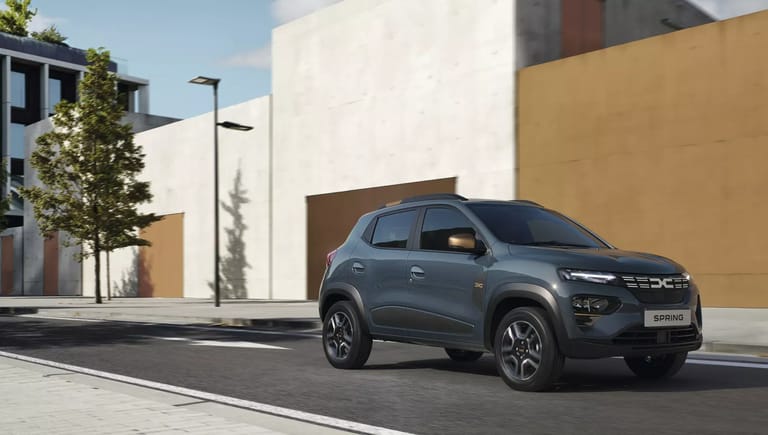
The 2025 restyling of the Dacia Spring consolidates this city car's position in the ultra-affordable segment of the French market. With an entry price of 16,900 euros, it targets short urban and suburban commutes without major budget compromises. Two electric motors of 45 and 65 horsepower powered by an identical 26.8 kWh battery offer a WLTP range of 225 kilometers. This technical specification reflects a clear philosophy: essential functionality at the most competitive price possible, far from technological over-engineering.
Design and habitability
The restyled Spring maintains its compact proportions typical of a 3.7-meter city car. Its reduced footprint facilitates parking in dense urban environments. Interior space remains limited but sufficient for two regular occupants or four in occasional trip configuration.
The 308-liter boot represents an asset for this category, complemented by a 35-liter frunk under the front hood. This arrangement, unusual for entry-level electric cars, offers appreciated additional storage for daily short trips.
The Extreme version features a 10-inch touchscreen, a modernization element that contrasts with the sobriety of the rest of the range. Interior materials remain simple, consistent with the stated pricing strategy.
Powertrain and performance
Two electric motors constitute the offer: the 45 horsepower version targets urban users with short commutes, while the 65 horsepower offers more liveliness for acceleration and hills. No torque or acceleration data is communicated by the manufacturer, which contrasts with industry standards for technical transparency.
The absence of manual transmission or gearbox simplifies mechanics. Regenerative braking in mode B allows energy recovery during deceleration, a standard function on this segment but representing genuine interest in frequent urban driving.
Range and charging
The WLTP range of 225 kilometers is identical for both versions despite the power difference. This stable data reflects the limited impact of the engine on the energy consumption of a lightweight city car. It suits home-to-work commutes under 100 kilometers round trip, with safety margins.
The 7 kW AC charging delivered as standard allows full recovery in approximately 4 hours on a domestic reinforced socket. Fast 30 kW DC charging offers useful partial recovery on long-distance trips, returning 80% battery in less than an hour. The V2L function (bidirectional charging) is a rare feature at this price point, allowing external devices to be powered via a dedicated outlet.
Equipment and technology
The 7 kW AC charger integrated as standard simplifies home installation without need for major infrastructure costs. The 10-inch touchscreen in the Extreme version represents the main technological element offered, providing access to navigation and climate control functions.
The V2L function scores a point: it authorizes direct powering of external electronic devices (smartphone, laptop) via a specific outlet, a feature usually reserved for higher-end models. The rest of the equipment displays assumed sobriety, without elaborate ADAS or autonomous driving systems.
Versions & Prix
45 ch
16 900 €
- Batterie : 26.8 kWh
- Autonomie : 225 km WLTP
- Puissance : 45 ch
- Recharge DC : 30 kW
- Recharge AC : 7 kW
65 ch
18 900 €
- Batterie : 26.8 kWh
- Autonomie : 225 km WLTP
- Puissance : 65 ch
- Recharge DC : 30 kW
- Recharge AC : 7 kW
Notre verdict
The Dacia Spring 2025 remains the most affordable electric city car on the market with an unbeatable price of 16,900 €. Perfectly suited for short urban trips and daily commutes under 200 km, it offers excellent value for money in terms of price-to-equipment ratio for a first electric purchase. Its entry-level positioning does not make it a direct competitor to premium electric city cars.
Points positifs
- + Unbeatable price at 16,900 € for a new electric with integrated battery and AC charger included.
- + 225 km range sufficient for typical daily urban and suburban commutes.
- + 308 L boot adapted to storage needs of a city car for urban use.
- + V2L function included allowing external devices to be powered, very rare at this price point.
- + 7 kW AC charger included as standard, avoiding additional installation costs for home charging.
Points négatifs
- – 225 km range limits occasional trips beyond 150-180 km without range anxiety.
- – Slow 30 kW DC charging, making long-distance trips uncomfortable on public networks.
- – Maximum power of 65 hp modest for acceleration and overtaking in mixed traffic.
- – Reduced habitability for 4-5 regular occupants with very stripped-down and basic interior.
- – Dacia network less dense than Tesla or traditional brands for maintenance and roadside assistance.
FAQ
- What is the range of the Dacia Spring 2025?
- The WLTP range is 225 kilometers for both versions (45 hp and 65 hp), identical despite the difference in engine power. This value covers short home-to-work commutes with safety margins under standardized driving conditions.
- How much does the Dacia Spring 2025 cost?
- The 45 horsepower version starts at 16,900 euros, while the 65 horsepower reaches 18,900 euros. These prices include the 7 kW AC charger as standard and V2L functions and regenerative braking.
- How long does it take to charge the Dacia Spring 2025?
- With 7 kW domestic AC charging, it takes approximately 4 hours to recover 100% battery on a reinforced socket. With 30 kW fast DC charging, 80% recovery is achieved in less than an hour, but full charge takes more time due to gradual power reduction.
- What battery does the Dacia Spring 2025 have?
- Both versions use an identical 26.8 kWh battery, sized for short urban and suburban use. No specific chemistry details (LFP, NCA, etc.) are specified by the manufacturer.
- What are the dimensions of the Dacia Spring 2025?
- The Spring measures approximately 3.7 meters in length, maintaining a compact city car footprint optimized for urban parking. The boot offers 308 liters of volume, supplemented by a 35 liter frunk under the front hood.