How to Choose the Best Mask for City Cycling and Pollution
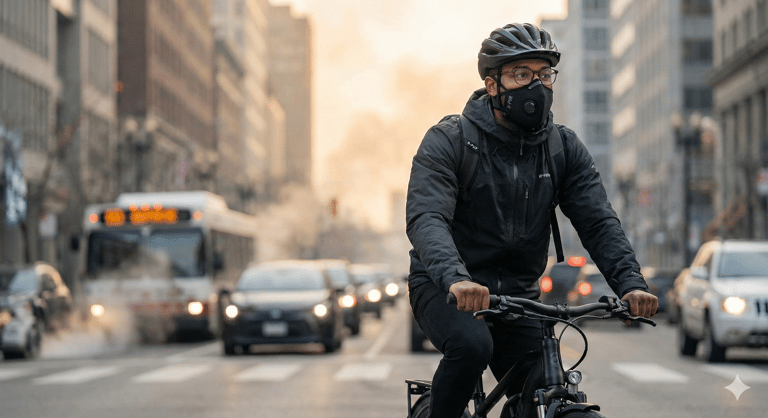
The urban mobility revolution is here. From London to Paris, and New York to Berlin, our streets are changing. More of us are ditching the car and hopping onto e-bikes, cargo bikes, and gravel bikes to navigate the concrete jungle. It is efficient, it is fun, and it is usually faster than sitting in gridlock. However, there is an invisible tax we pay for this freedom: air pollution.
When you ride a bike in the city, you are not just a road user; you are an athlete in a toxic environment. Cyclists breathe deeper and faster than pedestrians or drivers. A study suggests that a cyclist can inhale up to three times more pollutants than a car driver on the same route. You are opening your lungs to a cocktail of nitrogen dioxide, unburnt fuel vapors, and fine particulate matter (PM2.5) that bypasses your body's natural defenses.
If you invest in a high quality helmet to protect your head, it makes logical sense to invest in high quality gear to protect your respiratory system. But the market is flooded with options. How do you distinguish between a medical gadget and a piece of serious cycling equipment? This guide will break down exactly how to choose the right gear for your daily commute.
The 4 Pillars of a Great Cycling Mask
Choosing a mask for riding is very different from choosing one for a subway ride or a hospital visit. The dynamics of cycling involve wind, sweat, physical exertion, and helmet straps. If a mask fails in any of these areas, it will end up in your pocket instead of on your face.
1. Filtration Technology: Look for "Nano" not just "Micro"
Most standard dust masks are rated to catch PM10 (pollen, heavy dust) or PM2.5 (fine combustion particles). While this is good, it is often not enough for the modern urban environment. The most dangerous pollutants from diesel engines are ultrafine particles, often smaller than 0.1 microns. These nanoparticles can cross into the bloodstream and cause systemic inflammation.
When reading the specs of a potential mask, look for filtration media that goes beyond the standard N95 rating. You want technology capable of capturing particles down to the nanometer scale. Additionally, look for an activated carbon layer. This is essential for neutralising gases like ozone and nitrogen dioxide, which are responsible for that acrid chemical smell you get when riding behind an old bus.
2. The Seal: The "Path of Least Resistance" Rule
This is the most critical factor that new buyers overlook. You can have the best filter material in the world, but if the mask does not seal perfectly against your skin, it is useless. Air works like water; it follows the path of least resistance. If there is a tiny gap near your nose bridge or under your chin, the dirty air will flow right through that gap, completely bypassing the filter.
For a cyclist, the seal is even harder to maintain because you are moving. You turn your head to check blind spots. You look down at your GPS. You shout at bad drivers. A rigid mask will break its seal during these movements. You need a mask with an adaptive sealing interface, usually made of memory foam or soft silicone, that moves with your face rather than fighting against it.
3. Breathability and Valve Efficiency
Cycling is an aerobic activity. Even on an e-bike, your oxygen demand increases. If a mask creates too much resistance to inhalation, you will feel suffocated and dizzy. This is known as "pressure drop." A good cycling mask must have a low pressure drop to allow for deep, rapid breathing.
This is where valves come in. While valves are sometimes discouraged in medical settings (to protect others), they are essential for high performance cycling masks. They act as exhaust ports. When you exhale hot, humid CO2, the valve opens instantly to dump the heat. When you inhale, it snaps shut to force air through the filter. Without high flow valves, your mask will become a hot, wet sauna within 10 minutes, and moisture buildup will degrade the filter's static charge.
4. Stability and Helmet Compatibility
How does the mask attach to your head? Simple ear loops are rarely enough for cycling. At 25 km/h on an e-bike, the wind pressure can push the mask sideways. Ear loops can also become painful if you are wearing sunglasses and a helmet strap behind your ears.
The best solution is a suspension system that fastens behind the neck or over the crown of the head. This "locks" the mask in place, ensuring it does not slide down your nose when you hit a pothole or look over your shoulder.
The Gold Standard: Why R-PUR Leads the Pack
After testing dozens of options against these strict criteria, one brand consistently sits at the top of the podium for urban riders: R-pur.
While many competitors adapted industrial masks for sports, R-PUR built their product from scratch specifically for the two wheeled commuter. They understood that a cyclist has different needs than a painter or a carpenter.
The "Soft-Fit" Advantage R-PUR masks utilize a patented thermal memory foam seal. When you put the mask on, the foam reacts to the heat of your skin and molds to your unique facial structure. This solves the two biggest complaints of cyclists: leakage and fogging. Because the seal is hermetic, no hot air escapes upwards to fog your sunglasses or visor. For anyone who rides in winter or rain, this feature alone is worth the investment.
Unmatched Filtration In terms of protection, they are in a league of their own. Their filter technology captures particles as small as 0.05 microns (nanoparticles), which offers a level of protection far exceeding standard European norms. Whether you are stuck in a tunnel or waiting at a busy junction, the air you breathe is scrubbed clean of heavy metals, bacteria, and allergens.
For those specifically looking for a dedicated cycling anti pollution mask, R-PUR offers the "Nano One" and "Nano Light" models. The Nano Light is particularly interesting for cyclists as it features a hyper breathable mesh shell, designed to keep you cool during intense summer rides while still providing maximum protection.
Other Contenders in the Market
While R-PUR is our top recommendation for the serious commuter, there are other options depending on your specific needs.
Respro (The Heavy Duty Option) Respro uses a neoprene shell which is incredibly durable. It is a favorite among motorcycle couriers because it can take a beating. The downside is that neoprene can be very warm, making it less ideal for pedaling hard in July, but excellent for keeping your face warm in January.
Airinum (The Fashion Forward Choice) If you want something that looks less "technical" and more "lifestyle," Airinum offers sleek, Scandinavian designs. They use a good multi layer filter, though the seal is generally less robust than the memory foam found on R-PUR models, making it better suited for moderate pace commuting rather than high speed riding.
Cambridge Mask Co (The Lightweight Alternative) These are lightweight fabric masks that use military grade carbon cloth. They are great for keeping in your pocket for short trips. However, the fit relies heavily on ear loops and a chin strap, which may not provide the rock solid stability needed for an e-bike commute at full speed.
How to Integrate a Mask into Your Routine
Once you have chosen your mask, treating it right will extend its life and your health.
Don't Over Tighten A common mistake is pulling the straps as tight as possible. This actually warps the seal and causes leaks. If you choose a mask with a memory foam seal like the R-PUR, let the foam do the work. It should sit comfortably on your face, not crush it.
Watch the "Saturation" Level Filters work like a sponge. Once they are full, they stop working. R-PUR has a fantastic mobile app that tracks your mileage and local air quality to tell you exactly when to change the filter. Do not guess. A clogged filter makes it harder to breathe and offers less protection.
Dry It Out After every ride, your mask will have some moisture inside from your breath. Do not stuff it in your bag immediately. Hang it up in a dry place to air out. This prevents bacteria growth and keeps the mask smelling fresh for your next commute.
Conclusion
The freedom of moving through the city on your own terms is unbeatable. You are saving money, you are saving time, and you are reducing the city's overall carbon footprint. But you must prioritize your own biological engine.
The air quality in our cities is improving, but it is not perfect yet. Until we have fully electric cities, a high performance mask is the smartest insurance policy you can buy for your long term health. Whether you choose the technical superiority of R-PUR or another brand, make sure it seals, filters nanoparticles, and lets you breathe freely. Ride safe, breathe clean, and enjoy the journey.